
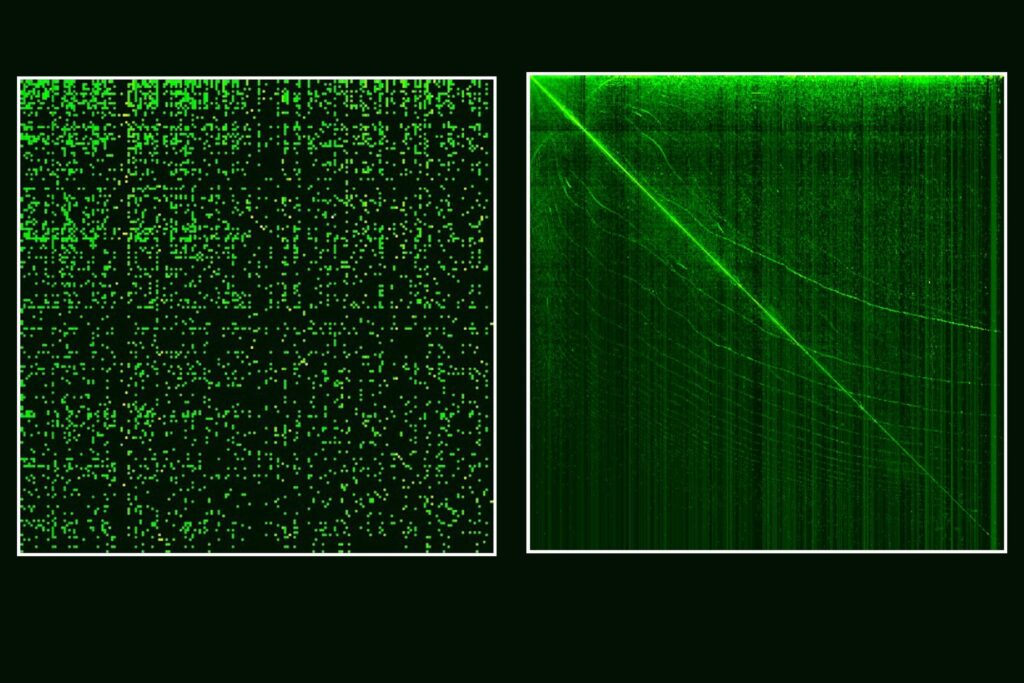
The Google Matrix is a mathematical model developed to help Google's PageRank algorithm determine the importance of web pages on the internet. It represents the web as a network of interconnected pages, where each page is linked to others through hyperlinks. In the matrix, every row and column represents a webpage, while each value indicates the probability of a user moving from one page to another by following a link. This model allows search engines to evaluate not only the number of links pointing to a webpage but also the quality and importance of those links.
One of the key features of the Google Matrix is the damping factor, which is usually set to 0.85. This value assumes that a user follows hyperlinks about 85% of the time, while the remaining 15% represents the possibility of jumping directly to any webpage instead of following a link. This random jump, known as teleportation, prevents the ranking process from getting stuck on pages with no outgoing links or within groups of pages that only link to each other. As a result, every webpage has a chance of being reached during the ranking process.
The Google Matrix is created using the formula G = αS + (1 − α)E, where S represents the hyperlink structure of the web, α is the damping factor, and E is the teleportation matrix. These components work together to produce a matrix that is stochastic, irreducible, and aperiodic. These mathematical properties ensure that the PageRank algorithm eventually reaches a stable solution, allowing each webpage to receive a unique ranking score.
The PageRank algorithm repeatedly applies the Google Matrix to calculate the importance of every webpage. Pages that receive links from other highly ranked and trustworthy pages generally achieve higher PageRank scores, making them more likely to appear near the top of search engine results. This approach helped improve the quality of search results by identifying pages that were both relevant and authoritative.
Although Google's search engine now uses many additional ranking signals, the Google Matrix remains one of the most important concepts in the history of search engine technology. It laid the foundation for modern web ranking systems and continues to be studied in fields such as network analysis, graph theory, citation analysis, recommendation systems, and social network analysis. Its ability to measure the importance of connected objects makes it useful far beyond web search.